How Much Does Etsy Take From Sellers? Complete Fee Breakdown for 2026
Find out exactly how much Etsy takes from sellers with a breakdown of all fees: listing, transaction, payment processing, and currency conversion. Includes real examples and tips to maximize profits.

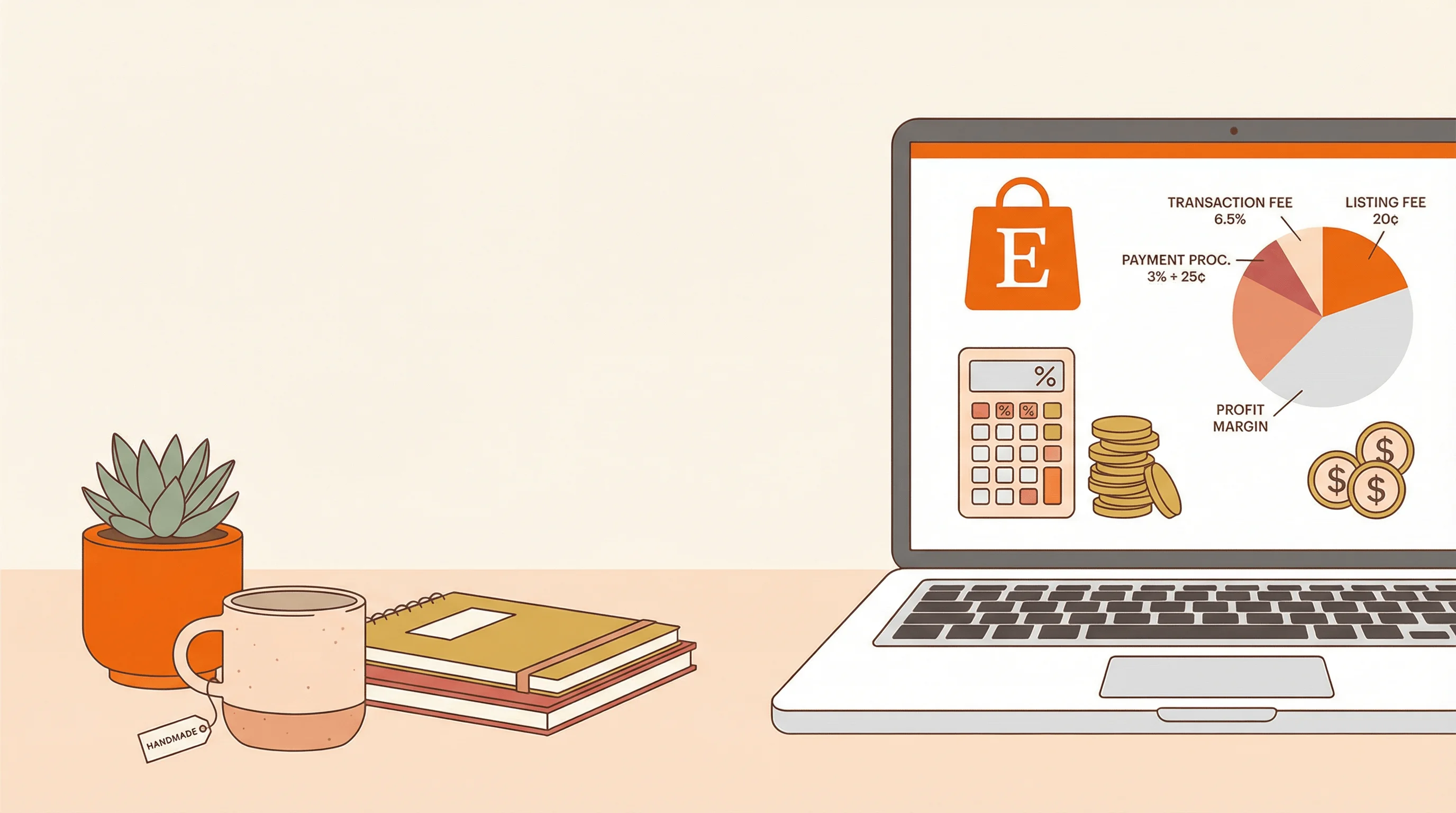
Selling on Etsy comes with a variety of fees that can affect your profit margin. Understanding these costs is crucial for pricing your products appropriately and running a profitable shop.
So how much does Etsy actually take from sellers? The short answer: for a standard sale without advertising, total fees typically amount to around 10% of the order total. However, this percentage can climb significantly if you use additional services like Offsite Ads—sometimes reaching around 20% of the sale.
In this guide, I'll break down every Etsy seller fee as of 2026, show you real-world examples for both U.S. and international sellers, and share tips for keeping more of your hard-earned money.
💡 Quick Tip: Want to calculate your exact profit for any sale? Use our free Etsy Fee Calculator to see your true net profit after all fees, shipping, and costs.
Quick Overview: Mandatory vs Optional Fees
Before diving into details, here's what you need to know: some Etsy fees are unavoidable, while others are optional or situational. Understanding this distinction helps you budget accurately.
Mandatory Fees (You Will Pay These)
| Fee Type | Amount / Rate |
|---|---|
| Shop Set-Up Fee | $15 USD (one-time, new shops only) |
| Listing Fee | $0.20 USD per listing (every 4 months or per sale) |
| Transaction Fee | 6.5% of item price + shipping + gift wrap |
| Payment Processing Fee | US: 3% + $0.25; UK: 4% + £0.20; EU: 4% + €0.30 |
| Currency Conversion Fee | 2.5% (only if listing currency ≠ payout currency) |
| Regulatory Operating Fee | 0.25–2% (only in certain countries) |
Optional Fees (Your Choice)
| Fee Type | Amount / Rate |
|---|---|
| Offsite Ads Fee | 12–15% of order (only if sale came via Offsite Ad)* |
| Etsy Ads (On-site) | You set a daily budget (pay-per-click) |
| Etsy Plus Subscription | $10 USD per month |
| Shipping Labels | Discounted rates (save up to 30%) |
*Note: Offsite Ads become mandatory if your shop exceeds $10,000 in annual sales.
As you can see, Etsy's cut isn't a single fee but a combination of several fees. The listing fee is a small flat charge to post each item. The transaction fee and payment processing fee together take the largest portion—roughly 6.5% + ~3–4% (plus a small fixed amount) of each transaction.
Let's break down each fee in detail.
Etsy Shop Set-Up Fee (One-Time)
Starting in 2024, Etsy introduced a one-time shop set-up fee of $15 USD for new sellers. This is charged when you create a new Etsy shop and is converted to your local currency at the time of opening.
During promotional periods, Etsy may waive this fee, but otherwise, consider it the initial cost to get your shop up and running. This set-up fee is paid only once and doesn't apply to existing shops—think of it as an "entry fee" to join the Etsy marketplace.
Listing Fees on Etsy
Every time you list a product for sale on Etsy, you incur a listing fee of $0.20 USD per item. This fee is charged upfront when you publish a listing (or when it renews after expiration) and covers a listing's presence on Etsy for 4 months or until the item sells—whichever comes first.
Key points about listing fees:
-
Flat $0.20 in USD: If your shop's bank account is in another currency, the $0.20 will be converted at the current rate. Canadian sellers see about $0.27 CAD per listing, UK sellers pay roughly £0.15 GBP.
-
Charged per listing and renewal: You pay this fee whether or not the item sells. If the item doesn't sell within 4 months and you renew the listing, another $0.20 fee is charged.
-
Multi-quantity listings: If you have multiple quantities of an item and it sells multiple times, Etsy charges the listing fee for each additional quantity sold after the first one.
-
No listing fee for edits: Editing a listing is free. You're only charged when creating or renewing.
Example: Imagine you list a handmade necklace for sale. It costs you $0.20 to create that listing on Etsy. If the necklace doesn't sell in four months and you decide to keep it listed, you'll pay another $0.20 to renew it. If you had 10 identical necklaces and listed them in one quantity of 10, the initial listing fee is $0.20; when one sells and the listing automatically renews to show the remaining quantity, Etsy charges another $0.20.
Listing fees are relatively small, but keep them in mind if you have a large catalog—multiple listings that sit unsold for months can accumulate costs.
Transaction Fees (Etsy's Commission per Sale)
The transaction fee is Etsy's commission for facilitating the sale of your item. Whenever you make a sale, you're charged a transaction fee of 6.5% of the total amount the buyer paid for the item plus any shipping or gift wrap charges. This rate was increased from 5% to 6.5% in 2022.
Key details about transaction fees:
-
Rate: 6.5% of the item price + shipping + gift wrap/personalization. For example, if you sell an item for $50 and charge $5 for shipping, the 6.5% fee applies to the $55 total, not just the item price.
-
No transaction fee on sales tax (US): If you're a U.S.-based seller and Etsy collects sales tax on the order, that tax amount is excluded from the 6.5% fee.
-
Same percentage globally: The 6.5% rate is the same for all sellers worldwide. A UK seller who sells an item for £100 will pay a £6.50 transaction fee, while a US seller's $100 sale incurs a $6.50 fee.
Example: Suppose you're a U.S. seller who sells a painting for $100 with free shipping. Etsy will take 6.5% of $100, which is $6.50 as the transaction fee. If instead you charged $90 for the item + $10 shipping (still $100 total), Etsy's 6.5% would still apply to the full $100, coming out to $6.50.
Payment Processing Fees (Etsy Payments)
If you use Etsy Payments (which most sellers do, and which is required in many countries), Etsy charges a payment processing fee for handling the transaction. This fee varies by country and consists of a percentage plus a fixed amount per transaction.
Payment processing fees by country:
| Country | Fee Rate |
|---|---|
| United States | 3% + $0.25 |
| United Kingdom | 4% + £0.20 |
| European Union | 4% + €0.30 |
| Canada | 3% + $0.25 CAD |
| Australia | 3% + $0.25 AUD |
| Other countries | 4.5% – 6.5% + fixed fee |
Important notes:
-
The processing fee is calculated on the total order amount including tax, shipping, and gift wrap—essentially the full amount the buyer paid.
-
For U.S. sellers, if Etsy collects and remits sales tax on your behalf, the payment processing fee still applies to the full amount (including tax).
-
Payment processing is a standard cost of doing business online—similar to what you'd pay with Stripe, PayPal, or any other payment processor.
Example: For a $55 total order (US), the payment processing fee would be: (3% × $55) + $0.25 = $1.65 + $0.25 = $1.90
Currency Conversion Fee
If you list items in a currency that differs from the currency of your linked bank account, Etsy charges a currency conversion fee of 2.5% of the sale amount.
For example, if you're a UK-based seller but list products in USD to appeal to American buyers, Etsy will convert the funds when depositing to your GBP bank account and charge 2.5% for that conversion.
How to avoid this fee:
- List items in the same currency as your bank account
- Consider opening a multi-currency account (like Wise or Payoneer) if you sell internationally in high volume
For occasional international sales, the 2.5% convenience fee might be worth it. But if you're doing significant volume in a different currency, it's worth finding ways to avoid this fee.
Regulatory Operating Fee
Sellers in certain countries are charged a small Regulatory Operating Fee on each sale. This fee helps Etsy cover costs related to regulatory compliance in specific regions.
Countries with regulatory fees:
| Country | Fee Rate |
|---|---|
| United Kingdom | 0.32% |
| France | 0.4% |
| Spain | 0.4% |
| Turkey | ~2% |
| Canada | 1.15% |
| Italy | 0.25% |
If you're not in one of these countries, you won't see this fee. If you are, it's a small additional cost on every order.
Example: A UK seller with a £100 order would pay £100 × 0.32% = £0.32 regulatory fee.
Offsite Ads Fee
Etsy runs advertising campaigns on external platforms like Google, Facebook, Instagram, and Pinterest to drive traffic to Etsy listings. If a buyer clicks on one of these Offsite Ads and makes a purchase within 30 days, Etsy charges an Offsite Ads fee.
Offsite Ads fee rates:
- 15% of the order total for shops that made less than $10,000 in the last 12 months
- 12% of the order total for shops that made $10,000+ in the last 12 months
Key points:
-
Opt-out available for smaller sellers: If you made less than $10,000 in the last 12 months, you can opt out of Offsite Ads in your shop settings.
-
Mandatory for larger sellers: If your shop made $10,000 or more in the last 12 months, participation in Offsite Ads is mandatory and you cannot opt out.
-
You only pay when you get a sale: Unlike Etsy Ads (pay-per-click), Offsite Ads only charge you when an ad leads to an actual purchase.
Example: If a buyer clicks an Offsite Ad for your $100 product and makes a purchase, and you're under the $10k threshold, you'd pay 15% × $100 = $15 Offsite Ads fee (on top of all other fees).
This is why total fees can sometimes reach 20%+ when Offsite Ads are involved.
📖 Deep Dive: For a comprehensive guide on managing Offsite Ads, including strategies to mitigate fees and community insights, read our full article on Etsy's Offsite Ads Fee in 2026.
Etsy Ads (On-Site Advertising)
Etsy Ads are optional pay-per-click advertisements that promote your listings within Etsy's search results and category pages.
Unlike Offsite Ads (which you may not be able to opt out of), Etsy Ads are completely optional. You set a daily budget, and Etsy charges you each time someone clicks on your promoted listing.
How Etsy Ads work:
- You set a daily budget (minimum $1/day)
- Etsy shows your listings in promoted placements
- You pay per click, regardless of whether it leads to a sale
- Average cost-per-click varies by category and competition
Should you use Etsy Ads?
Etsy Ads can be effective for boosting visibility, especially for new listings. However, track your return on ad spend (ROAS) carefully. Many sellers find that certain products are profitable with ads while others aren't worth advertising.
Etsy Plus Subscription
Etsy Plus is an optional monthly subscription that costs $10 USD per month and provides premium shop features:
- 15 listing credits per month ($3 value)
- $5 Etsy Ads credit per month
- Customizable shop options (banner templates, featured listings)
- Discounts on custom domain and packaging
- Restock requests for out-of-stock items
Whether Etsy Plus is worth it depends on your shop's needs. For shops with high listing turnover or those who actively use Etsy Ads, the credits can offset most of the monthly cost.
Shipping Labels (Etsy Shipping)
If you use Etsy Shipping Labels, you can purchase and print shipping labels directly from your Etsy account. This isn't a fee—it's actually a way to save money.
Benefits of Etsy Shipping Labels:
- Save up to 30% on shipping costs from USPS, FedEx, and Canada Post
- Print labels directly from your Etsy account
- Automatic tracking number added to orders
- Orders marked as shipped automatically
- Helps you qualify for Etsy's Star Seller badge
How it works:
When you purchase a shipping label through Etsy, the cost is deducted from your payment account. You pay the discounted carrier rate, not retail prices. This can significantly reduce your shipping costs, especially for heavier items.
In-Person Selling Fee (Square Integration)
If you have a physical store or sell at craft fairs and use Square as your point-of-sale system, you can sync your Etsy listings with your in-store inventory.
How the fee works:
- Synced listings: No extra charge beyond normal listing fees when your Square inventory syncs with Etsy
- Manual sales: If you sell an item via Square that's not synced with Etsy, you're charged a $0.20 "Square manual" fee
This integration ensures your inventory stays accurate across both online and offline sales channels. Square also charges its own processing fees (2.6% + $0.10 for in-person transactions).
Real-World Fee Calculation Examples
Let's put it all together with two realistic examples.
💡 Calculate Your Own Fees: Instead of doing manual calculations, use our free Etsy Fee Calculator to instantly see your profit after all fees, shipping costs, and discounts. It handles all the complex calculations for you.
Example 1: U.S. Seller, $55 Total Sale
A U.S.-based seller sells a handmade item for $50 + $5 shipping = $55 total.
| Fee Type | Calculation | Amount |
|---|---|---|
| Listing Fee | Flat rate | $0.20 |
| Transaction Fee | 6.5% × $55 | $3.58 |
| Payment Processing | (3% × $55) + $0.25 | $1.90 |
| Total Fees | $5.68 | |
| Seller Receives | $55 - $5.68 | $49.32 |
Effective fee rate: 10.3% of the order total
Example 2: UK Seller, £100 Sale to International Buyer
A UK-based seller sells an item for £100 (including free shipping) to a buyer who pays in USD.
| Fee Type | Calculation | Amount |
|---|---|---|
| Listing Fee | ~£0.16 (converted from $0.20) | £0.16 |
| Transaction Fee | 6.5% × £100 | £6.50 |
| Payment Processing | (4% × £100) + £0.20 | £4.20 |
| Currency Conversion | 2.5% × £100 | £2.50 |
| Regulatory Operating Fee | 0.32% × £100 | £0.32 |
| Total Fees | £13.68 | |
| Seller Receives | £100 - £13.68 | £86.32 |
Effective fee rate: 13.7% of the order total
As you can see, international sellers often face higher effective fee rates due to payment processing variations, currency conversion fees, and regulatory fees.
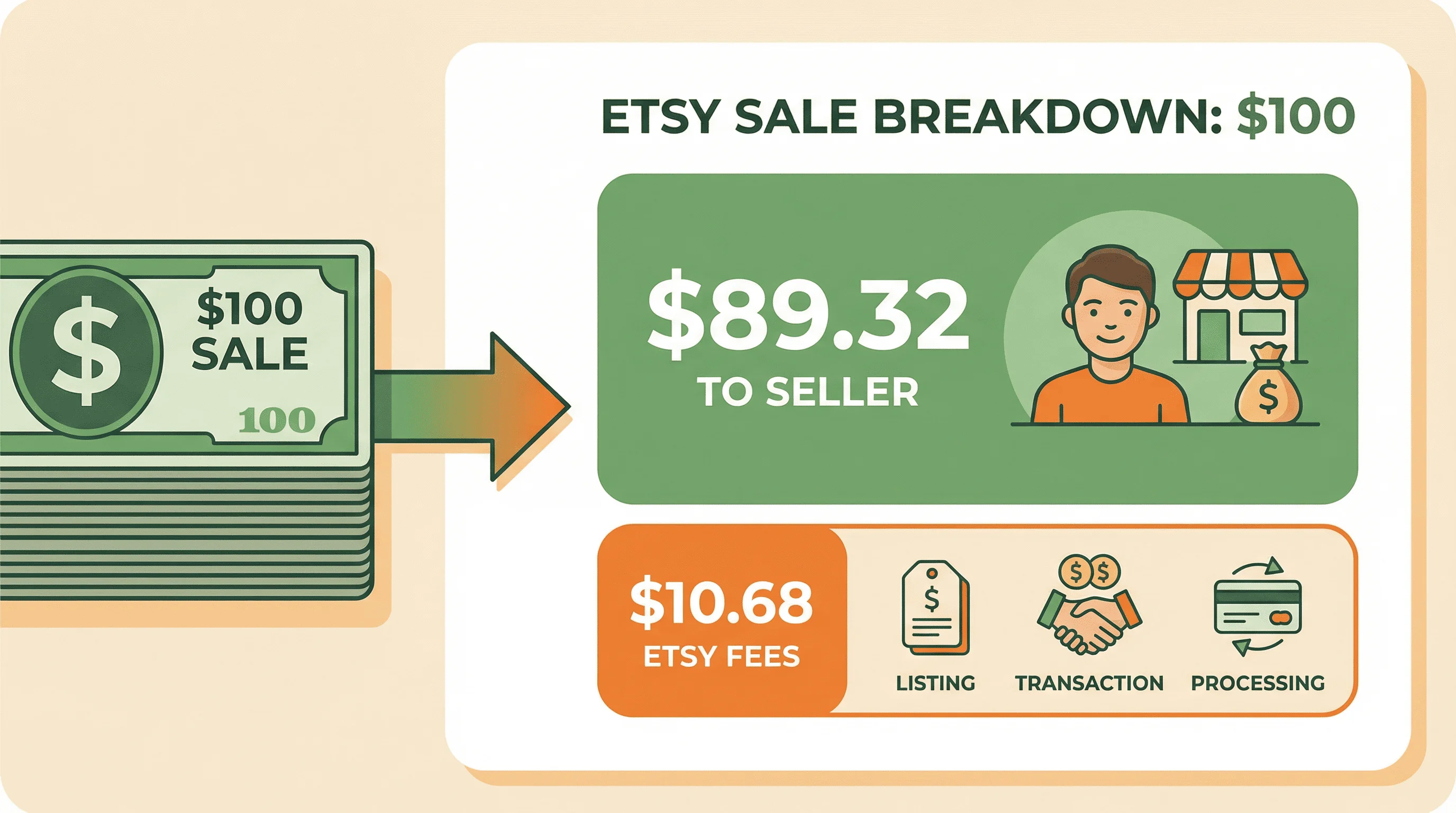
Example 3: What Your Etsy Bill Actually Looks Like
Here's a realistic example showing exactly what appears on your Etsy statement when you sell a handmade candle:
Sale Details:
- Candle price: $25.00
- Shipping charged: $6.00
- Sales tax collected: $2.48
- Customer pays: $33.48
Your Etsy Bill:
| Line Item | Amount |
|---|---|
| Listing fee | -$0.20 |
| Transaction fee (6.5% of $31) | -$2.02 |
| Processing fee (3% of $33.48 + $0.25) | -$1.25 |
| Total Etsy fees | -$3.47 |
| Sales tax (remitted to state) | -$2.48 |
| Your deposit | $27.53 |
The breakdown:
- Customer paid: $33.48
- Etsy's cut: $3.47 (10.4% of item + shipping)
- Sales tax (pass-through): $2.48
- You keep: $27.53
If this sale came from an Offsite Ad and you're under the $10k threshold, add another $4.65 (15% of $31), bringing your total fees to $8.12—or 26% of your sale.
Tips to Minimize Etsy Fees and Maximize Profits
Now that you understand all the fees, here are strategies to keep more of your earnings:
1. Price Your Products to Account for Fees
Factor in at least 12-15% for Etsy fees when setting prices. If you want to earn $40 on a product, price it around $46-48 (not $40).
2. Opt Out of Offsite Ads (If Eligible)
If you made less than $10,000 in the last 12 months, go to Shop Manager → Settings → Offsite Ads and opt out. This saves you the potential 15% fee on externally-driven sales.
3. Avoid Unnecessary Currency Conversion
List products in the same currency as your bank account to avoid the 2.5% conversion fee.
4. Bundle Products to Reduce Per-Item Fees
Selling a bundle as a single listing means one $0.20 listing fee instead of multiple. Plus, higher-value orders dilute the fixed payment processing fee.
5. Manage Your Listing Inventory Carefully
Don't let hundreds of listings sit unsold for months. Each renewal costs $0.20. Regularly review and remove listings that aren't performing.
6. Track Your True Profit Margins
Use a spreadsheet or accounting tool to track actual profits after all Etsy fees. Many sellers are surprised to discover their true margins. Our free Etsy Fee Calculator makes this easy—just enter your sale price, shipping, and costs to see your exact profit margin. Then pair margin tracking with conversion benchmarking using our guide on what is a good conversion rate on Etsy.
7. Use Analytics Tools to Optimize Listings
Tools like EverBee and Alura can help you identify which products are most profitable and optimize your listings for better visibility. This data-driven approach helps you focus on products with the best profit margins after fees.
Tips for Etsy Success (Beyond Just Fees)
Minimizing fees is important, but building a successful Etsy shop requires more:
1. Curate Your Etsy Selection Strategically
Don't list everything at once. Start with your best-sellers or most unique items. This helps you:
- Test which products perform well on Etsy's marketplace
- Avoid paying listing fees for items that don't sell
- Create a focused brand identity that attracts your ideal customers
Consider offering sampler packs or bundles to introduce buyers to your full range.
2. Optimize Every Listing for Etsy Search
Etsy's search algorithm determines who sees your products. Focus on:
- Titles: Use all 140 characters with relevant keywords
- Tags: Use all 13 tags with long-tail keywords buyers actually search
- Photos: First photo matters most—use bright, clear images
- Descriptions: Front-load important details in the first few lines
3. Build Your Own Customer Base
While Etsy brings buyers to you, smart sellers build direct relationships:
- Include a thank-you card with your website or social links
- Collect email addresses (where allowed) for announcements
- Use Pinterest marketing to drive traffic you control
This reduces dependence on Etsy's algorithm and Offsite Ads over time.
How Etsy Fees Compare to Other Platforms
Wondering if Etsy's fees are competitive? Here's a quick comparison:
| Platform | Typical Total Fees |
|---|---|
| Etsy | ~10-13% (up to 20% with Offsite Ads) |
| Amazon Handmade | 15% referral fee |
| Shopify | 2.9% + $0.30 (payment processing only) |
| eBay | ~13-15% (fees + payment processing) |
| Your Own Website | ~2.9-3.5% (payment processing only) |
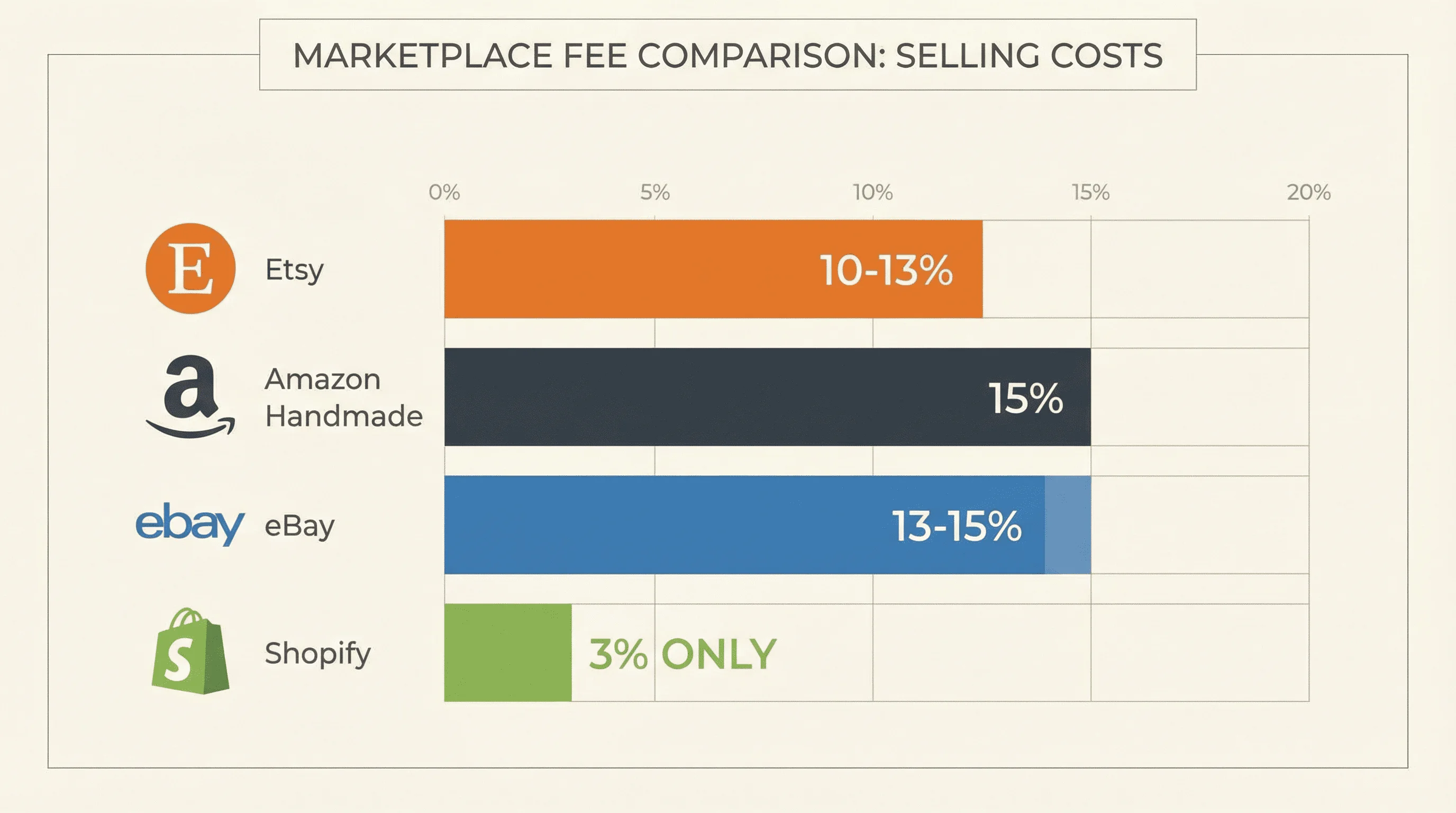
Etsy's fees are in line with other marketplaces. The tradeoff is access to Etsy's built-in audience of millions of buyers actively searching for handmade and unique items.
Driving Traffic to Your Etsy Shop: If you're using platforms like Pinterest to drive traffic to your Etsy shop, understanding your total fees helps you calculate whether that traffic is profitable. Learn more about Pinterest marketing strategies for Etsy sellers to maximize your return, and check out our data-driven look at whether Pinterest and Etsy are still worth it in 2026.
The Bottom Line: Is Etsy Worth the Fees?
After understanding all these fees, you might wonder: is selling on Etsy still worth it? The answer depends on your business goals, but here's the honest assessment.
Why Etsy Is Worth It
Built-in audience: Etsy has over 90 million active buyers specifically looking for handmade, vintage, and unique items. You don't need to spend money driving traffic—the buyers are already there.
Trust and credibility: New sellers benefit from Etsy's established reputation. Buyers trust Etsy's payment protection and return policies, making them more likely to purchase from unknown shops.
Low barrier to entry: With just $15 to open a shop and $0.20 per listing, you can test products with minimal investment compared to building your own website.
The Downsides to Consider
Shrinking margins: The ~10% base fee (up to 20%+ with Offsite Ads) means you need to price higher or accept lower profits. This can make it hard to compete on price-sensitive items.
Rising fees: Etsy has increased fees twice since 2018. The transaction fee jumped from 5% to 6.5% in 2022. There's no guarantee fees won't increase again.
Your brand is secondary: Customers come to Etsy for Etsy. Many buyers don't remember individual shop names, making it harder to build brand loyalty and repeat customers.
Increasing competition: Etsy's growth has attracted millions of sellers, making it harder to stand out without paid promotion.
The Smart Approach: Etsy as Part of Your Strategy
The most successful sellers use Etsy as one channel in a broader strategy—not their only sales avenue.
Consider:
- Use Etsy to validate products and find your audience
- Build your own website to capture higher-margin sales and own the customer relationship
- Diversify across platforms (Etsy, your site, local markets) to reduce dependence on any single channel
Etsy's fees are the cost of accessing their marketplace. As long as you price accordingly and treat it as one piece of your business puzzle, it can be a valuable sales channel.
Conclusion: Understanding Etsy's Take
Etsy provides a powerful platform to reach millions of buyers, but that reach comes at a cost. For a typical sale, Etsy's fees total around 10% of the order amount. Factor in Offsite Ads or currency conversion, and that can rise to 15-20%.
The key takeaways:
- Mandatory fees (listing + transaction + payment processing) = approximately 10%
- Currency conversion adds 2.5% if applicable
- Regulatory fees add 0.25-2% in certain countries
- Offsite Ads can add 12-15% when triggered
- Optional services (Etsy Ads, Etsy Plus) have separate costs
- Always price products with fees in mind—aim for 12-15% buffer minimum
By understanding exactly where your money goes, you can price strategically, make informed decisions about optional features like Offsite Ads and Etsy Plus, and ultimately run a more profitable Etsy shop.
For most sellers, Etsy remains a valuable channel despite the fees—especially when used as part of a broader sales strategy that includes your own website and marketing efforts.
Frequently Asked Questions
Q: What percentage does Etsy take from each sale?
A: For a standard sale, Etsy takes approximately 10% in total fees (listing fee, 6.5% transaction fee, and ~3-4% payment processing). This can rise to 15-20% if Offsite Ads or currency conversion apply. To calculate your exact fees for any sale, use our free Etsy Fee Calculator.
Q: Can I avoid Etsy's Offsite Ads fee?
A: If your shop made less than $10,000 in the past 12 months, yes—you can opt out in your shop settings. If you made $10,000+, participation is mandatory.
Q: Does Etsy charge fees on shipping?
A: Yes. The 6.5% transaction fee and payment processing fees apply to the total order amount, including shipping charges.
Q: Are Etsy fees tax-deductible?
A: Yes, Etsy fees are a business expense and can typically be deducted on your taxes. When filing Schedule C, you'll need to select the right business activity code—check out our NAICS Codes Guide for Etsy Sellers to choose the correct classification for your shop.
Q: How does Etsy compare to selling on my own website?
A: On your own website, you'd only pay payment processing fees (~3%). However, you'd also need to drive your own traffic and handle all marketing, which has its own costs.
Q: Is Etsy still worth it with all these fees?
A: For many sellers, yes. Etsy provides access to millions of active buyers, handles payment processing and trust, and offers built-in search visibility. The fees are the cost of that infrastructure and audience.
Q: What tools can help me optimize my Etsy shop?
A: Tools like EverBee and Alura can help you research profitable products, analyze competitor pricing, and optimize your listings. These tools are especially valuable when you understand your total Etsy fees and can calculate whether the tool investment improves your profit margins.
Q: What sells best on Etsy?
A: The most popular categories on Etsy include jewelry (especially personalized pieces), handmade crafts, vintage items (20+ years old), home décor, wedding items, digital downloads (planners, printables, patterns), and custom/personalized gifts. Products that are unique, customizable, or hard to find in big-box stores tend to perform best. For a detailed breakdown of profitable product ideas, check out our guide to the top items to sell on Etsy.
Q: Is Etsy a good side hustle?
A: Etsy can be an excellent side hustle, but expectations matter. Most sellers earn under $1,000/year, while top sellers can make six figures. Success depends on product selection, pricing strategy, marketing effort, and time investment. Start with products you can make efficiently, price to account for all fees, and treat it like a real business—even if it's part-time.
Q: What is the biggest downside of Etsy?
A: The biggest downsides are: (1) fees that can reach 20%+ with Offsite Ads, (2) intense competition from millions of other sellers, (3) limited control over your brand experience, and (4) dependency on Etsy's algorithm and policies which can change without warning. Many successful sellers eventually diversify to their own website to reduce these risks.
Q: How much does it cost to start an Etsy shop?
A: The minimum cost to open an Etsy shop is $15.20: the $15 one-time shop set-up fee plus $0.20 for your first listing. However, budget for additional listings ($0.20 each), photography equipment, packaging materials, and potentially shipping supplies. Most serious sellers invest $100-500 to launch properly.
Q: Do I need a business license to sell on Etsy?
A: Etsy doesn't require a business license to open a shop, but your local, state, or country laws might. In the US, requirements vary by state and city. You may also need to collect sales tax (Etsy handles this in most US states), report income on your taxes, and potentially register your business name. Consult a local accountant or check our NAICS codes guide for business classification help.
Related Resources
- Top Items to Sell on Etsy in 2026 — Discover profitable product categories and trending items
- Etsy Fee Calculator — Calculate your exact profit after all Etsy fees instantly
- Etsy's Offsite Ads Fee Explained — Deep dive into the 12-15% Offsite Ads fee and how to manage it
- NAICS Codes for Etsy Sellers — Choose the right business classification code for taxes and registration
- EverBee vs Alura Comparison — Find the best Etsy analytics tools to optimize your shop
- Pinterest Marketing Mistakes to Avoid — Drive traffic to your Etsy shop without paying for ads
Sources
This guide references official Etsy documentation and trusted third-party resources:
- Etsy Fees & Payments Policy – Official documentation of all Etsy seller fees and terms
- Etsy Payments Policy – Official payment processing rates by country
- What is a Regulatory Operating Fee? – Etsy Help Center explanation of country-specific regulatory fees
- How Much Etsy Takes From a Sale – Gelato's comprehensive fee breakdown with examples
- Etsy Fees: How Much Does It Cost to Sell on Etsy? – Made on the Common's overview of new fees
- Etsy Seller Fees - Complete Guide – Alex Tooby's detailed breakdown with historical context
Last Updated: January 25, 2026
Category: E-commerce
Reading Time: 14 minutes
Found this guide helpful? Share it with fellow Etsy sellers who want to understand exactly where their money goes!